
When Eternity Drew Near: Christianity and the Civil War Soldier
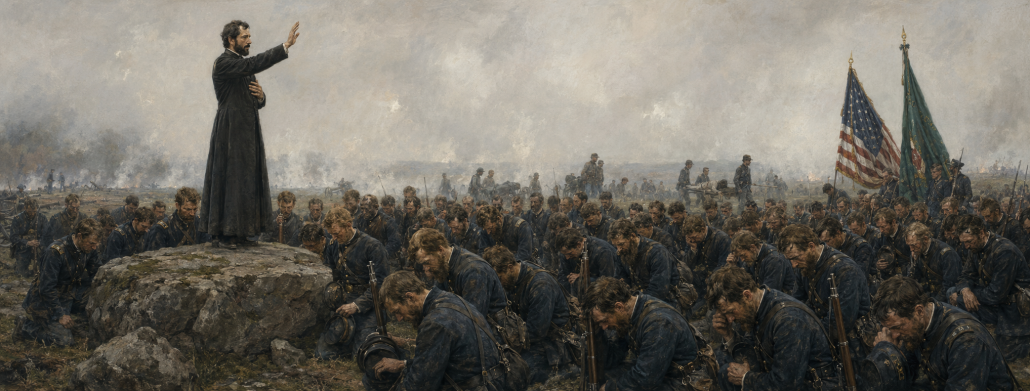
On the afternoon of July 2, 1863, Father William Corby climbed onto a granite boulder along Cemetery Ridge at Gettysburg and raised his right hand.
He was thirty years old, lean and dark-haired, with a full beard that did little to hide his youth. A priest of the Congregation of Holy Cross and chaplain of the 88th New York Infantry, Corby had spent nearly two years following the Army of the Potomac. He had slept in its camps, marched beside its soldiers, tended men under fire, heard the confessions of the wounded, and administered the last rites to the dying. [1]
The granite rock stood near the George Weikert farm, on the Union line south of Gettysburg. It was tall enough to lift Corby above the men gathered below, though hardly a pulpit. Today, a bronze likeness of Corby stands on the battlefield, his left hand pressed to his chest and his right extended, palm open, in blessing. It is the gesture of a priest pronouncing absolution over men preparing to die. [1]
Before him stood the Irish Brigade, five regiments drawn largely from Irish immigrants and their sons in New York, Massachusetts, and Pennsylvania. They wore the same dark blue coats and battered forage caps as the rest of the Union army, but their green regimental flags, embroidered with golden harps and shamrocks, proudly announced who they were.
Once several thousand strong, the Irish Brigade arrived at Gettysburg with about 530 men fit for duty. [2]
At Antietam, they had advanced to within yards of a sunken farm road and poured buck-and-ball into Confederate ranks until the lane filled with bodies and earned a new name: Bloody Lane. More than 500 men of the brigade were killed or wounded there. Three months later, at Fredericksburg, roughly 1,200 Irishmen, many with sprigs of boxwood in their caps, marched toward the stone wall below Marye’s Heights. Confederate rifle and artillery fire tore through them. More than 500 fell. [3]
By Gettysburg, the once-mighty brigade had been reduced to the strength of a small regiment. On the afternoon of July 2, its survivors waited behind Cemetery Ridge as the battle raged beyond them.
Artillery thundered across the ridge. Musket fire rose and fell in ragged volleys. Smoke hung over the fields, sharp with sulfur and burned powder. Wounded men staggered back alone or sagged between fellow soldiers, hats gone, faces gray, hands pressed against blood-soaked cloth. Others passed on stretchers. Some did not move at all.
The Irish Brigade had been ordered forward to help hold the Union left. Between the men and the collapsing line lay open ground, the Wheatfield, and Confederates advancing through the woods beyond it.
They knew enough about war to know what awaited them.
Corby asked permission to address the brigade. He proposed to give the men general absolution; the forgiveness of sins pronounced over a group when individual confession was impossible. There was no time for hundreds of men to confess one by one. The battle would not wait for the sacraments.
Standing on the boulder, Corby explained what the men must do. Each was to confess his sins sincerely before God, make an act of contrition, and resolve to seek individual confession at the first opportunity.
At his instruction, the men lowered their weapons, dropped to their knees, and bowed their heads. Catholics knelt. Protestants knelt. Officers removed their hats. Men in neighboring units fell silent. Corby raised his hand over them and spoke the Latin words of absolution while cannon fire shook the air.
Then he stepped down.
The men rose, shouldered their rifles, and formed their ranks. The flags lifted. Orders passed down the line. Only moments earlier, they had been kneeling before God. Now they moved down the slope toward the Wheatfield, through powder smoke, the cries of the wounded, and the sickening wreckage of men already carried from the fight. Before sunset, nearly 200 of the brigade’s 530 remaining men would be killed, wounded, or missing. [1][2]
Corby later wrote that his absolution was intended not only for the Irish Brigade, but for all who were prepared to receive it, “North or South,” and who were about to appear before their Judge. [1]
Corby’s absolution did not stop the battle, and it did not spare the men.
It was not meant to.
Across the divided country, faith would meet soldiers in much the same place: between fear and duty, home and battlefield, life, death, and whatever came after.
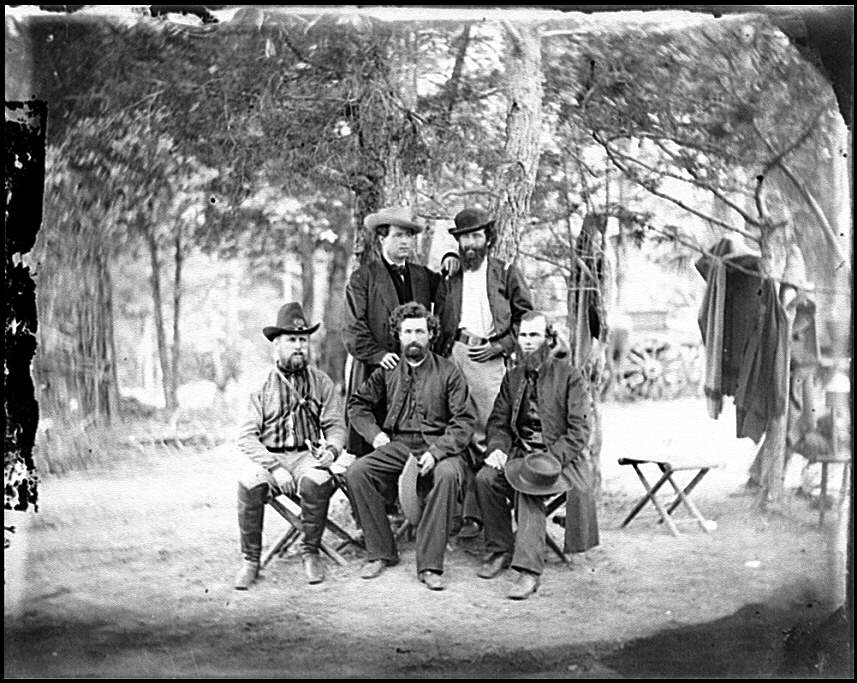
Father William Corby, seated at right, with fellow Holy Cross priests and members of the Irish Brigade at Harrison’s Landing, Virginia, July 1862. Photograph by Alexander Gardner. Library of Congress.
Faith in the Ranks
Christian faith was everywhere in the Civil War. It traveled in coat pockets and haversacks. It was printed on paper, stamped into metal, sung beneath trees, preached from stumps, whispered in hospital wards, and scratched into letters home. Soldiers carried pocket Testaments, prayer books, crosses, rosaries, and medals. They built log chapels in winter camps and held prayer meetings beneath canvas when no chapel could be had. [4]
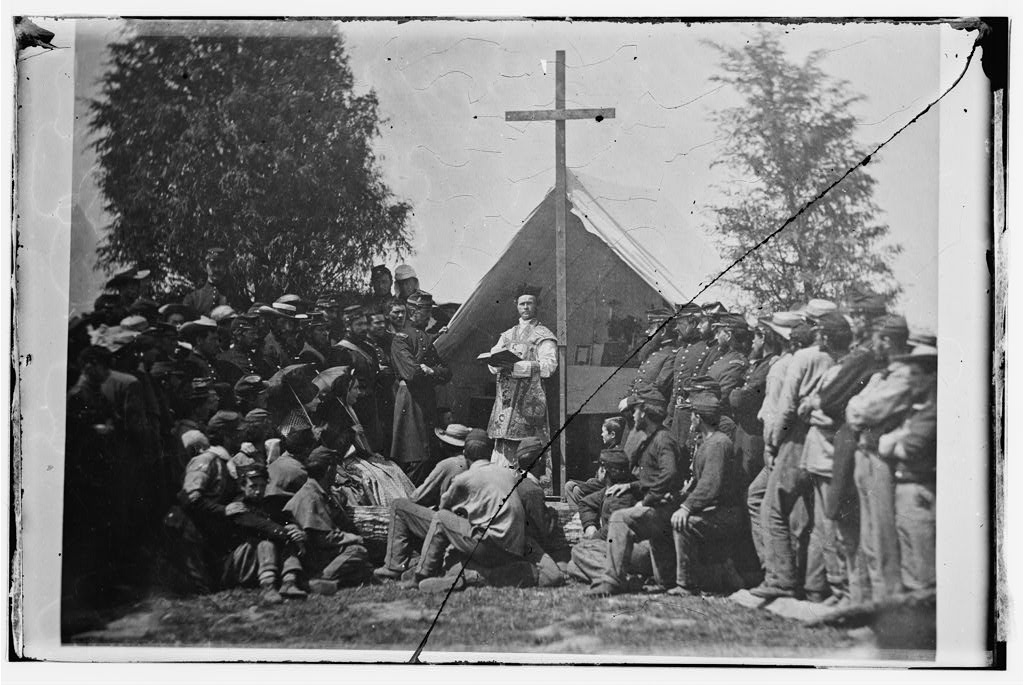
Father Thomas H. Mooney celebrates Sunday Mass for the 69th New York State Militia at Fort Corcoran, Virginia, June 1, 1861. Library of Congress.
They prayed before battle. They prayed after battle. In battle, prayer shed its ceremony. It became a cry for help, a plea for mercy, a promise hastily made, or the name of Jesus forced through clenched teeth while the world came apart.
The Civil War drove men from churches into camps, from pews onto battlefields, and from ordinary life into daily companionship with death. There, Christianity ceased to be merely something heard on Sunday morning. Eternity might be nearer than the time it took to reload a musket.
And yet, there was a terrible complication.
The men across the field were praying too.
They read the same Bible, called upon the same God, sang many of the same hymns, and asked Christ to receive their souls. Then, when the order came, they rose from prayer and tried to kill one another. They succeeded with horrifying efficiency.
Read the Book: A Holy Baptism of Fire and Blood: The Bible and the American Civil War
To understand Christ in the Civil War is to enter that contradiction. Faith brought courage, comfort, repentance, mercy, and hope amid the worst bloodshed the nation had ever known. It also became tangled with politics, patriotism, slavery, self-interest, and the stubborn human habit of assuming that God sees things exactly as we do.
A Religious Nation Breaks Apart
The soldiers who marched off to war in 1861 came from a nation steeped in religion.
For decades, evangelical revivals had swept through towns, farms, and frontier settlements. Preachers delivered sermons in churches, schoolhouses, barns, and open fields. Methodist circuit riders traveled wherever a horse could carry them. Baptists planted congregations with considerable energy and little need for grandeur. Presbyterians brought a strong tradition of ordered worship, formal doctrine, educated clergy, and representative church government. In nineteenth-century America, even spontaneity had its denominations.
Bible societies distributed Scripture. Tract societies, charitable organizations formed to print and distribute short works of Christian teaching, turned out religious pamphlets by the millions. Sunday schools taught children to read through biblical passages. Newspapers carried sermons, testimonies, denominational arguments, and reports of revivals. Americans disagreed about doctrine, baptism, church government, free will, predestination, and nearly everything else Christians have found to disagree about. Most still believed that God governed nations as well as men.
War did not teach Americans to look to God. They entered it with convictions shaped by decades of preaching, revival, and Scripture.
But the faith they carried was no more united than the country. Churches had split, congregations had fractured, and geography increasingly shaped what Christians believed Scripture permitted, especially concerning slavery.
Long before Southern states left the Union, some of America’s largest churches had already split along sectional lines. The Methodist Episcopal Church fractured over slavery in 1844, with Southern Methodists formally organizing their own denomination the following year. Baptists divided in 1845 after their national mission organizations refused to appoint slaveholders as missionaries. Presbyterians had split earlier over theology and church practice, then fractured further along sectional lines as disputes over slavery sharpened. In 1861, the Old School Presbyterians divided North from South with the country itself. [5]
The churches did not merely reflect the coming national crisis. In some respects, they previewed it.
Slavery sat at the center of the division. Christians living in the Northern states held a wide range of views, from immediate abolition to indifference, prejudice, and resistance to any interference with the institution. Many white Christians living in the Southern states went further, defending slavery not as an unfortunate inheritance, but as a social order permitted, and even sanctioned, by Scripture.
The Bible was appealed to by those demanding freedom and by those denying it.
Enslaved Christians heard the story of Moses and Pharaoh and recognized a God who delivered people from bondage. Slaveholders read the same book and found passages they believed preserved their authority. Both could quote Scripture. Only one was free.
By the time soldiers began gathering in camps, the nation’s religious institutions had already learned how to divide Christ by geography and issue. Americans have seemingly preserved that particular tradition with near apostolic care.
Northern churches sent ministers, missionaries, Bibles, tracts, supplies, and prayers into Union camps. Southern churches did the same for Confederate soldiers. Sermons presented the war as a test of faithfulness. Clergymen asked God to preserve their armies, strengthen their leaders, and defeat the enemy.
The enemy, meanwhile, was attending a similar service.
Read the Book: The Civil Was as a Theological Crisis
It would be easy to look back and dismiss all of this as hypocrisy. Some of it certainly was. Religion has never lacked for men willing to borrow God’s authority for their own purposes.
But hypocrisy does not explain everything.
Many soldiers were sincere. They feared God. They loved their families. They believed they were defending their homes, their country, their freedom, or the Union. Some came to see emancipation as a sacred cause. Others fought for a Confederacy created to preserve slavery while insisting that their own reasons were deeply personal and exceptionally local. Still others enlisted because their friends did, because adventure beckoned, because honor demanded it, or because a uniform looked considerably more appealing before anyone had been shot at.
Their motives could be noble, selfish, principled, contradictory, and sincere all at once. People have always managed to carry more than one thing in the same heart.
War did not simplify them. It took their time, comforts, privacy, illusions, and nearly every distraction that kept a man from thinking about his own death.
Once enlisted or conscripted, soldiers discovered that martial glory involved far less glory than advertised. There were long marches, bad food, wet blankets, lice, disease, homesickness, boredom, and officers whose competence did not always match their confidence. Battles were brief. Misery was punctual.
Death was everywhere but never dignified. It arrived through lead bullets and iron shells, but more often through fever, infection, diarrhea, pneumonia, and diseases that could sweep through a regiment faster than enemy fire. A healthy young man might fall ill in the morning and be dead before his family knew he had been sick.
Battle made death impossible to keep at a distance. When the firing stopped, the fields were strewn with men in blue and gray, some dead, others calling for water, their mothers, or God. The wounded lay where they had fallen until stretcher bearers could reach them, which might take hours or days. Men searched faces for friends and turned bodies over to learn who would not answer roll call. Death wore familiar faces now.
In war, questions about God were no longer theoretical.
A soldier wanted to know whether he was ready to die. He wanted to know whether death had meaning. He wanted to believe that no general, no government, and no weapon of war held the final claim on his life.
For many men, the answer was carried close to the heart.
Faith Carried Close
A soldier carried nearly everything he owned, and much of what he valued, on his back or in his pockets.
His haversack might contain rations, eating utensils, hardtack, tobacco, writing paper, spare socks, and whatever small comforts had survived the march. His knapsack held clothing and a blanket when he had not discarded them to lighten the load. His cartridge box carried the means to kill. His pockets carried the reasons to live.
There might be a photograph of a wife or sweetheart, a lock of hair, a letter from home, an engraved coin, a watch, or a scrap of paper bearing an address. Alongside them, many soldiers carried tangible expressions of their faith.
For Protestants, it was often a pocket Bible or New Testament.
The American Bible Society had been founded in 1816, decades before the war, for the purpose of making Scripture widely available. It began supplying members of the military almost immediately, sending Bibles to sailors aboard the USS John Adams in 1817. [6]
The Civil War transformed that established mission into a massive undertaking.
A standard Bible was poorly suited to army life. It was too large, too heavy, and too vulnerable to rain, mud, and the ruthless arithmetic of a long march. Soldiers routinely abandoned accoutrements, blankets, overcoats, and other useful possessions when exhaustion took command. Across thirty miles of heat, mud, broken ground, and hard marching, a full-sized Bible could quickly become more burden than comfort.
The solution was a New Testament small enough to slip into a shirt or coat pocket.
In 1861, the American Bible Society began printing an edition specifically intended for soldiers. Its printing presses ran at remarkable speed as requests poured in from regiments, chaplains, hospitals, churches, and aid organizations. By the end of the war, the society had distributed more than 1.5 million Bibles, New Testaments, and portions of Scripture through direct military work and its partnership with the United States Christian Commission. [7]
Those books went primarily to Union soldiers, but not exclusively. The society maintained that Confederate soldiers needed Scripture too. Getting it to them was another matter.
The Union blockade restricted the flow of books, paper, ink, and nearly everything else into the South. Southern Bible and tract societies struggled to print enough material for Confederate troops. Some New Testaments came through the blockade from Britain. Others were printed on Southern printing presses using whatever paper and supplies could be obtained. At least one shipment intended for Confederate soldiers was captured before it reached them. One surviving New Testament still bears the history of its interrupted journey. [8]
Even the Bible could become a prisoner of war.
The books that made it into soldiers’ hands were read, marked, rain-stained, and carried until their covers were worn smooth and the corners of their pages curled. Some contained inscriptions written before the soldier left home. Mothers urged sons to read daily. Wives added names and dates. Ministers underlined passages. Sunday school teachers offered reminders to resist the temptations of camp, which were plentiful, persistent, and rarely far away.
These inscriptions made mass-produced books deeply personal. A Testament might have come from a New York press, but the handwriting inside belonged to home.
Catholic soldiers carried different, though equally personal, expressions of faith. Some wore crucifixes, medals, scapulars, or rosaries. Such things were made to be held, worn, and carried through weather and war.
The value of these objects was not that they guaranteed a soldier would return home. It was that they carried a piece of home with him.
A Bible might recall a mother’s voice; a prayer book, the words of a familiar church; a medal, the faith of the family and country left behind. They were opened beside campfires, held in prisons, pressed into wounded hands, and sometimes returned home without the men who had carried them.
The soldier carried the object. The object reminded him that he was known, loved, and not alone.
The Holy Gospel on Cheap Paper
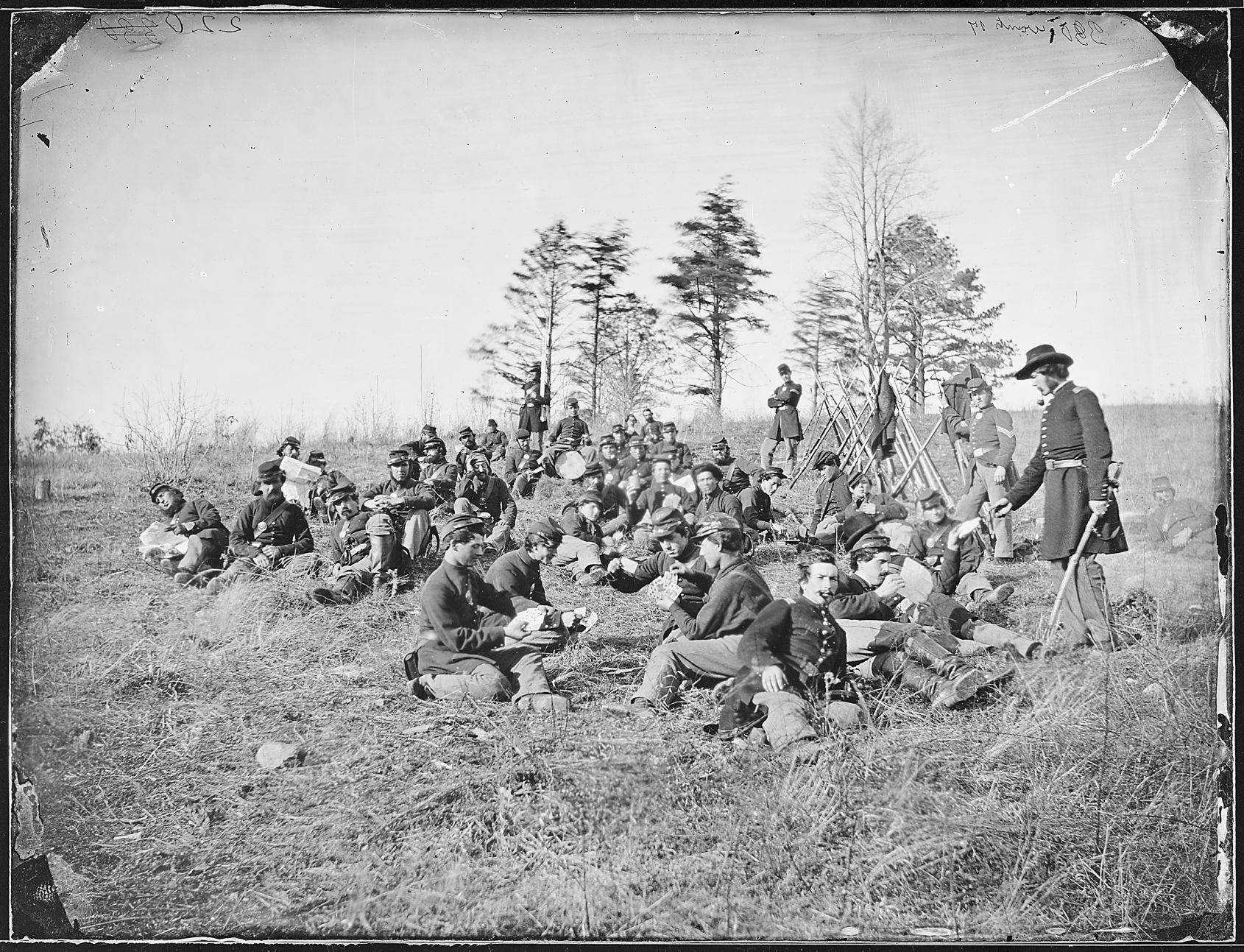
Union soldiers read letters and newspapers, talk, and play cards after drill near Petersburg, Virginia, in 1864. National Archives.
War required food, ammunition, clothing, horses, medicine, and an astonishing quantity of paper. Armies used it for orders and reports. Publishers turned it into newspapers. Soldiers filled it with assurances that they were well, often while hungry, sick, frightened, and lying through their teeth.
A printed page could go where a preacher could not. Folded into a pocket or haversack, the Gospel followed a soldier from camp to march, into battle, and sometimes onto a hospital cot.
The American Tract Society flooded Union camps with short sermons, hymns, prayers, conversion stories, and warnings against drinking, gambling, profanity, and other reliable features of army life. Most tracts ran only a few pages, making them cheap to print, easy to carry, quick to read, and simple to pass along. The society distributed tens of millions of printed pages during the war. [10]
The United States Christian Commission joined that effort in late 1861. Organized by Protestant leaders and supported by churches across the North, it sent civilian delegates into camps and hospitals with food, clothing, medical supplies, stationery, Bibles, and tracts. The delegates wrote letters for wounded men, read Scripture aloud, held services, and helped soldiers send word to families who knew neither where they were nor whether they were alive. [9]
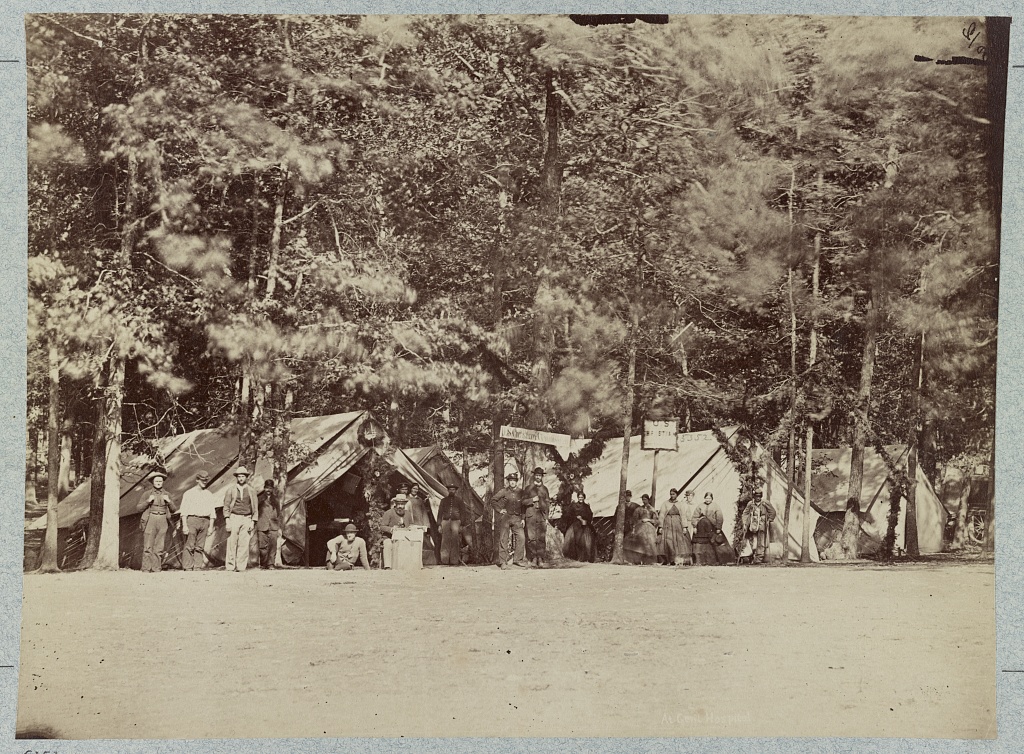
Members of the United States Christian Commission at Camp Letterman, the general hospital established at Gettysburg after the battle, August 1863. Library of Congress.
The Confederacy developed its own network. The Evangelical Tract Society of the Confederacy, denominational boards, Bible societies, missionaries, and colporteurs printed and distributed whatever they could. Paper shortages made the work difficult. So did inflation, poor transportation, lost territory, and a blockade that had no respect for publishing schedules. [10]
Yet the presses kept printing. Religious newspapers were trimmed in size. Tracts were printed on coarse paper. Sermons were condensed. When material became scarce, every inch mattered. The physical quality declined while the demand rose.
The titles got to the point: Prepare to Meet Thy God. Where Are You Going? For the Soldiers: Are You Ready? [10]
The message was equally direct. Camp life was temporary. Death was near. Salvation could not be postponed.
Not every soldier welcomed the effort. Tracts were ignored, misplaced, used to light pipes, and likely put to other practical purposes their publishers did not envision. Soldiers remained soldiers, and printed warnings about vice have never eliminated vice with notable efficiency.
But many read them. Some kept them. Others gathered around a man who could read them. A small tract might pass through a tent, a company, or a hospital ward until the paper weakened at its folds.
The paper was cheap. The promise printed upon it was eternal.
Revival Among the Ranks
When the war began, many soldiers expected to be home within months. By 1863, that illusion was gone.
The armies had buried friends, survived epidemics, endured defeat, and watched promised victories produce another campaign. Homesickness deepened. Men who once imagined death as a glorious possibility had seen what artillery did to a body.
Across both armies, prayer meetings grew larger. Soldiers gathered for preaching, testimony, hymn singing, and what were called experience meetings, where men described how they had come to faith. The gatherings often crossed rank, class, and denomination. Revival spread not only through crowded services, but through private Bible reading and small prayer groups that moved quietly from tent to tent. [11]
The most famous revival unfolded in the Confederate Army of Northern Virginia after Gettysburg.
During the fall of 1863 and the winter that followed, soldiers constructed chapels near their camps along the Rapidan River. Meetings filled them. When there was no room inside, men stood beyond the doors and listened in the cold. Chaplains and civilian ministers preached night after night. Thousands professed faith, sought baptism, or returned to beliefs neglected since leaving home.
Religious revival also spread through the Union Army of the Potomac. Brigades raised chapel tents and built churches during the winter of 1863 and 1864. Prayer meetings drew soldiers who had once shown little interest. The two armies faced one another across Virginia, preparing to resume the killing in spring, while men on both sides knelt in worship. [12]
William Jones became the best-known chronicler of the Confederate Revivals.
Jones was a young Baptist minister who served as a chaplain and evangelist in the Army of Northern Virginia. He preached to soldiers under A. P. Hill, Stonewall Jackson, and Robert E. Lee, helped organize the army’s chaplains, and recorded conversions and baptisms. In one year, he reportedly baptized more than 220 men. [13]
Two decades after the war, Jones gathered letters, reports, recollections, and his own experiences into Christ in the Camp; or, Religion in Lee’s Army. The book preserved a religious history of the Confederate soldier that might otherwise have been lost. It also helped build another history.
Jones became one of the leading architects of the Lost Cause, the postwar effort to portray the Confederacy as noble, slavery as incidental, and defeat as sanctified sacrifice. He defended the righteousness of the Southern cause and wrote with the certainty of a man who had never been overly troubled by doubt. Historian Charles Reagan Wilson later called him “the evangelist of the Lost Cause.” [13]
Christ in the Camp remains a valuable historical source, but it must be read with a clear understanding of its author and full purpose.
Jones estimated that as many as 150,000 Confederate soldiers accepted Christ during the war. The number is repeated often but cannot be verified with precision. Recordkeeping was uneven, definitions of conversion varied, and the man doing the counting had a powerful interest in presenting the Confederate army as a Christian host. [13]
Still, the revival itself was real. Letters, diaries, chaplains’ reports, religious newspapers, baptismal accounts, and testimony from multiple armies leave little doubt that thousands of soldiers experienced sincere conversion or renewal.
The more interesting question is not whether every number can be proved.
It is why men surrounded by death became so concerned with how to live.
The Bible That Stopped a Bullet
On August 12, 1862, Reverend Davis Foster gave Charles W. Merrill a small New Testament. Merrill was leaving West Newbury, Massachusetts, to join the 19th Massachusetts Infantry. His pastor’s gift went into his coat pocket and followed him to Virginia.
On May 3, 1863, at the Second Battle of Fredericksburg, Merrill’s brigade came under fire near Confederate rifle pits. An exploding shell scattered musket balls and fragments over the withdrawing Union soldiers.
One ball struck Merrill near his right eye, passed through his head, and lodged behind his ear.
Another struck the New Testament over his heart.
The pages caught the ball.
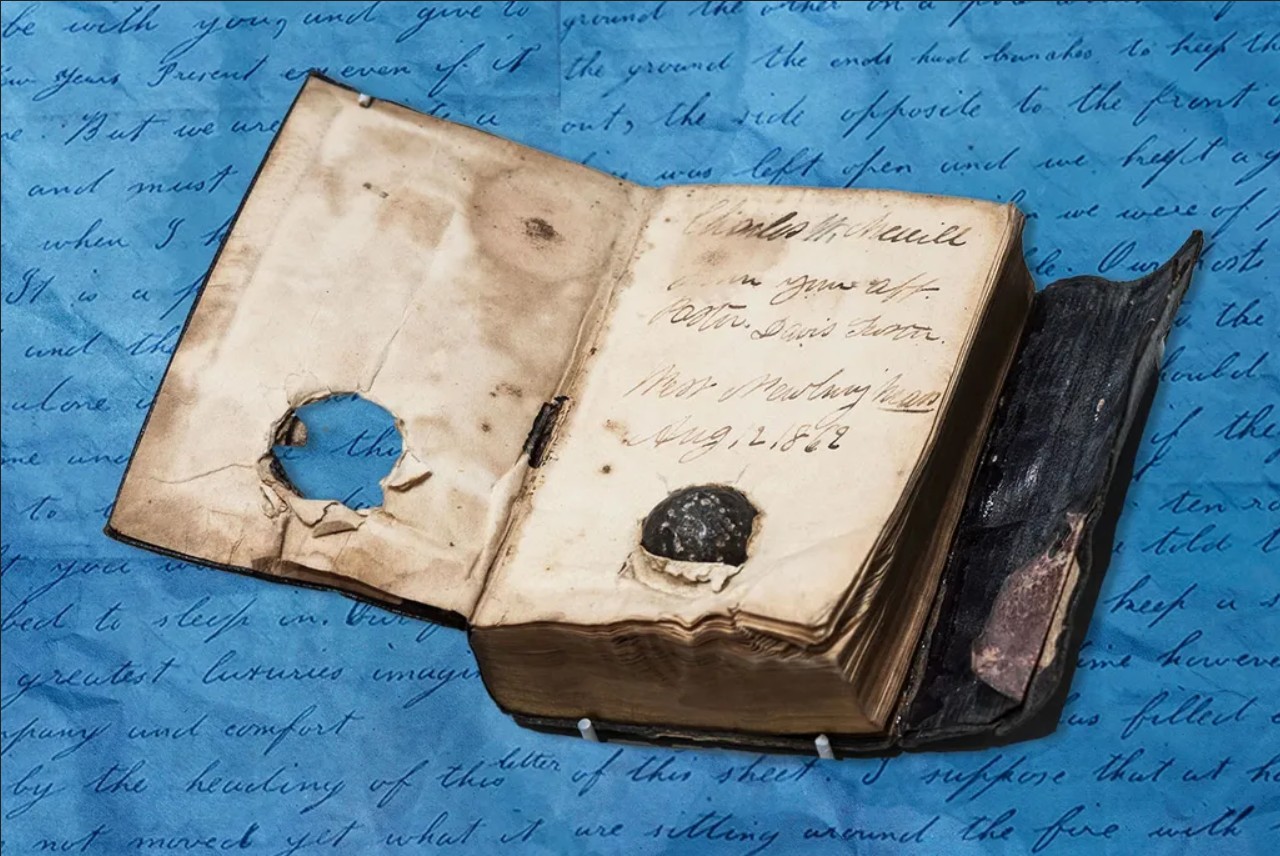
The pocket New Testament that stopped a musket ball over Charles W. Merrill’s heart at the Second Battle of Fredericksburg on May 3, 1863. Merrill survived the shot but died nine days later from his other wound. Phillips Library, Peabody Essex Museum, Rowley, MA / Kathy Tarantola
Merrill was carried to a field hospital at the Lacy House, where surgeons removed the ball from behind his ear. He was later sent to Washington. Journalist Benjamin Perley Poore, a family acquaintance, wrote to Merrill’s father that without the Testament, he likely would never have seen his son again.
The damaged Testament was shown to Abraham Lincoln. The president sent Merrill another Bible, inscribed with his name and the date, May 8, 1863.
For several days, Merrill appeared to be recovering. He wrote to his parents, credited the care of his “Heavenly Father,” and told them not to worry. Then, in a postscript that sounds like every older brother trying to protect the children at home, he added, “Don’t let the little folks know that I have lost my right eye.”
On May 12, an artery ruptured. Merrill began bleeding from his head wound and died within minutes.
His family had been preparing for his return. His younger brothers and sisters had gathered toys to keep him occupied while he recovered.
The New Testament had stopped a bullet. It had not stopped death.
It gave Merrill nine more days to write home and assure his family of his faith. The book remains today with the musket ball buried in its pages. [14]
Stories of bullet-struck Bibles appear throughout Civil War history. Some are documented by surviving books and contemporary letters. Others improved with age, as war stories tend to do.
Merrill’s story needs no embellishment.
Soldiers did not carry Scripture because it promised bullets would miss them. They carried it because they knew the bullets might not.
The God of Both Armies
The revivals leave a hard question: What does sincere faith mean when the cause it serves is unjust?
Thousands of Confederate soldiers may have sincerely repented of personal sins while continuing to fight for a nation created to protect the institution of slavery. Their conversions may have been real. So was the cause their army defended.
Sincerity matters, but it does not settle the moral question. A person can pray honestly and still misunderstand God. A preacher can quote Scripture accurately and apply it terribly. Faith can humble a man, or it can convince him that heaven has endorsed what he already wanted.
The same caution belongs in the Union camp. Not every Union soldier was an abolitionist. Many carried deep racial prejudice. Some fought only to preserve the Union and resisted emancipation. The United States entered the war promising not to disturb slavery where it existed and came slowly, painfully, and incompletely to make freedom a war aim.
Black Christians did not have the luxury of treating slavery as a theological abstraction.
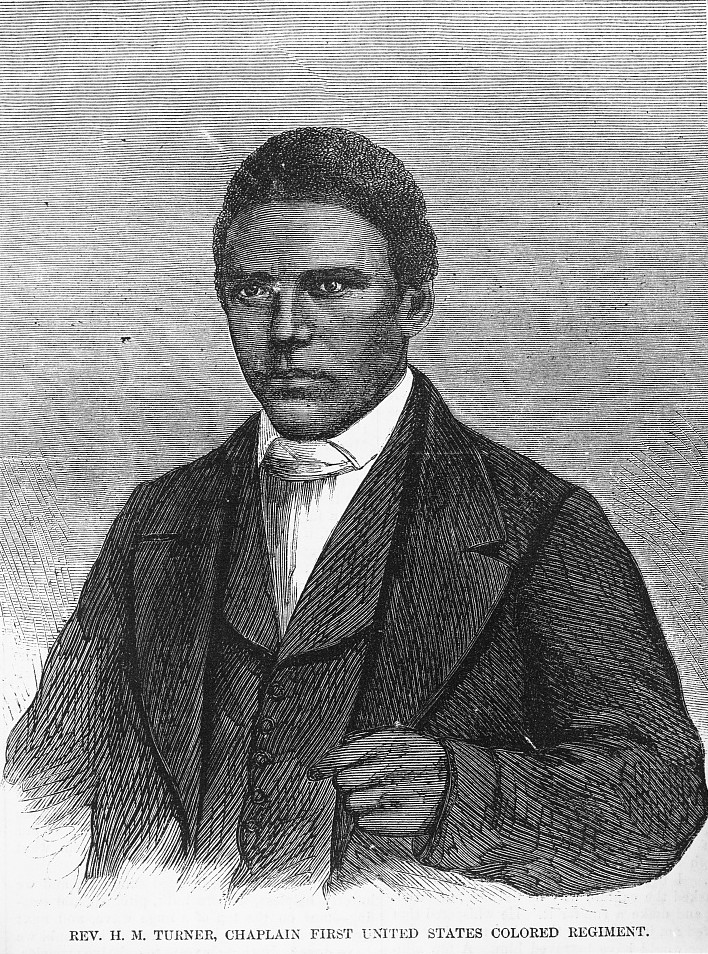
Reverend Henry McNeal Turner, chaplain of the First United States Colored Troops, as depicted in Harper’s Weekly in 1863. Library of Congress.
Enslaved people heard white ministers preach obedience while families were sold apart. They worshiped in churches controlled by slaveholders and in secret gatherings beyond white supervision. They heard in Exodus what other Christians refused to hear: God did not merely comfort the captive. He delivered the captive from bondage.
For Black soldiers, faith and military service carried a direct claim to freedom and citizenship.
Reverend Henry McNeal Turner helped recruit the First United States Colored Troops and became the first Black chaplain appointed to the Union Army. He preached, prayed, distributed medicine and food, taught soldiers to read, and wrote about the war for The Christian Recorder. For Turner, the bloodshed was not evidence that God had abandoned the nation. It was judgment upon a nation that had refused “right, equity, and justice.” [15]
Turner knew emancipation alone would not complete the work. He wanted the men of his regiment prepared not only for battle, but for freedom. He distributed spelling books, newspapers, religious literature, laws, and copies of the Emancipation Proclamation. His ambition was to leave every man in the regiment able to read and write. [15]
His ministry revealed another meaning of Christ in camp. Faith was not only preparation for death. It was preparation for life as a free man.
The prayers rose from both sides. What each side asked God to bless was another matter.
A Nation’s Reckoning
By March 1865, the Confederacy was collapsing.
Richmond remained in Confederate hands, but Lee’s army was trapped in the trenches around Petersburg. Sherman had taken Atlanta, marched through Georgia, and entered the Carolinas. Union victory was close, though more men would die before it arrived.
On March 4, Abraham Lincoln stood on the east portico of the United States Capitol and delivered his second inaugural address.
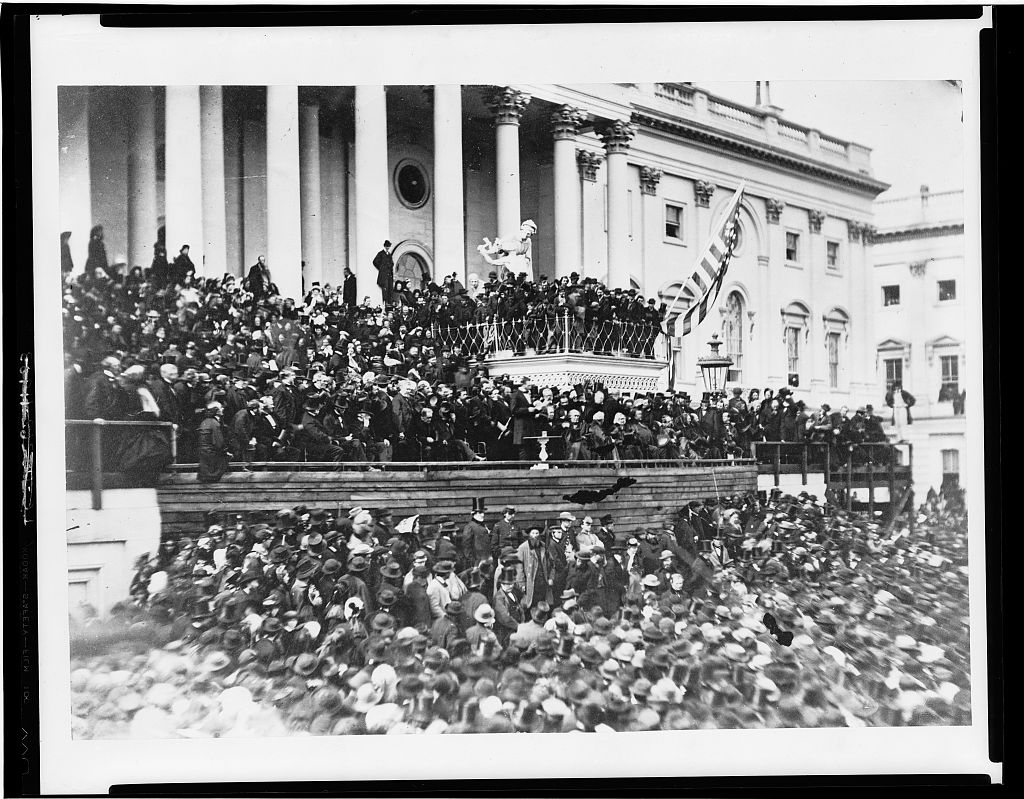
Abraham Lincoln delivers his second inaugural address from the east front of the United States Capitol on March 4, 1865. Lincoln stands beneath the flag near the center of the photograph. Photograph by Alexander Gardner. Library of Congress.
He did not celebrate.
He offered no victory speech, no boast of Northern righteousness, and no easy claim that God had chosen a favorite. Lincoln looked instead at four years of bloodshed and asked what judgment might mean for the entire nation.
“Both read the same Bible and pray to the same God,” he said, “and each invokes His aid against the other.” [16]
But Lincoln did not leave the matter there. He named slavery. He spoke of wealth wrung from the labor of enslaved people and considered whether the war was divine judgment for the offense, North and South together. Victory did not make the Union innocent. Defeat did not make the Confederacy noble. Neither side possessed God.
“The Almighty has His own purposes,” Lincoln said. [16]
That may be the most honest place to end the search for Christ in the Civil War.
He was invoked in sermons, sought in prayer, received in sacraments, and carried in pocket Testaments. Men found courage in Him, comforted the dying in His name, and credited Him with victories He had not explained. They also claimed His authority to defend slavery, bless armies, condemn enemies, and make human purposes sound divine.
The objects that survived preserve that tension: a pocket Bible bearing a mother’s inscription, a tract folded into a haversack, and a medal worn close to the heart. Small enough to hold in one hand, they remain heavy with the questions of a nation.
They cannot tell us whom God favored. They tell us what men held close when courage failed, forgiveness mattered, hope grew thin, and death drew close.
In camps, on fields torn by shot and shell, and beneath hospital canvas, when eternity drew near, men in both armies reached for the mercy of God.
Sources
- Notre Dame Archives, “Father Corby at Gettysburg”
- Stone Sentinels, “Irish Brigade at Gettysburg”
- National Museum of Civil War Medicine, “Under Erin’s Harp: The Irish Brigade”
- National Archives, “Faith in the Fight: Civil War Chaplains”
- Encyclopedia Virginia, “Religion During the Civil War”
- American Bible Society, “Our Story”
- Dunham Bible Museum, “They Read the Same Bible”
- Museum of the Bible, “Captured Civil War New Testament”
- National Museum of Civil War Medicine, “The United States Christian Commission”
- Encyclopedia.com, “Religious Tracts”
- Encyclopedia Virginia, “Religious Revivals During the Civil War”
- Christian History Institute, “Revivals in the Camp”
- New Georgia Encyclopedia, “J. William Jones”
- Smithsonian Magazine, “The Bible That Stopped a Bullet”
- Military Chaplaincy Review, “Right, Equity, and Justice”
- National Park Service, “Lincoln’s Second Inaugural Address”


Leave a Reply
Want to join the discussion?Feel free to contribute!